

Rita Has Two Small Containers
Ratio Proportion Quiz i for IBPS Clerk 2018 – Solve At present!
Testbook | Updated: Nov 22, 2018 19:00 IST
If you are preparing for Banking, Insurance and other Competitive Recruitment or Entrance exams, you will likely need to solve a section on Quant. Ratio Proportion Quiz i for Banking & Insurance Exams will aid yous learn concepts on an important topic in Quant – Ratio Proportion. This Ratio Proportion Quiz 1 is important for exams such as IBPS PO, IBPS Clerk, IBPS RRB Officer, IBPS RRB Office Assistant, IBPS SO, SBI PO, SBI Clerk, SBI SO, Indian Mail Payment Banking concern (IPPB) Scale I Officeholder, LIC AAO, GIC AO, UIIC AO, NICL AO.
Watch the beneath video to learn Ratio and Proportion in detail –
Ratio Proportion Quiz 1 for Cyberbanking & Insurance Exams –
Que. i
A block was divided into 5 equal minor parts. 2 of the small parts were then every bit distributed amid 7 children. What fraction of the original cake did 1 kid become?
Solution
Answer:
Since, cake is divided into 5 equal parts so, one small function =i/5 function of cake
2 of the small parts were and so as distributed among 7 children,
⇒ vii children get = 2 × 1/5 = two/five function of original cake
⇒ 1 kid gets = (2/7) × (1/5) = 2/35 function of original block
Que. 2
Priya, Rita and Sita accept a sum of Rs. 217 together. Rita has two/three of what Priya has and Sita has\(\frac{iii}{5}\)of what Rita has. How much money does Priya have?
Solution
Answer:
For sake of simplicity, let'southward denote Priya as 'P', Rita equally 'R' and Sita as 'S'.
P + R + S = 217 —-(1)
R=2P/iii and Due south = 3R/5
\(\; \Rightarrow S = \;\frac{3}{5} \times \frac{ii}{3}P = \frac{2}{five}P\)
⇒ S = 2P/5
Substituting these values in statement (1),
\(P + \frac{ii}{3}P + \frac{2}{5}P = 217\)
\(\Rightarrow P\left( {\frac{5}{3} + \frac{2}{5}} \right) = 217\)
\(\Rightarrow P\left( {\frac{{31}}{{xv}}} \correct) = 217\;P = \frac{{217 \times fifteen}}{{31}} \Rightarrow 7 \times 15 = 105\)
Hence, Priya has Rs. 105.
Que. 3
729 ml of a mixture contains milk and water in the ratio of vii : 2. How much more water is to be added to get a new mixture containing milk and water in the ratio 7 : 3?
Solution
Reply:
Since 729 ml of mixture contains milk and water in the ratio 7 : 2,
Amount of milk = (7/nine) × 729
= 567 ml
Amount of water = 729 – 567 = 162 ml
Allow, 10 ml of h2o is added.
⇒ 567 : (162 + x) = 7 : 3
Solving,
x = 81 ml
Hence, we volition need to add 81 ml of water to the mixture to make the ratio of milk and h2o as 7 : 3.
Que. 4
In a pocketbook there are notes of Rs 100, Rs fifty & Rs 10 in the ratio ii : iii : 5. If the total amount in the bag is Rs. 400, how much amount (out of the total) is fabricated up by Rs. 50 notes?
Solution
Answer:
Let the no. of Rs. 100 notes be 2x
and the no. of Rs. fifty notes be 3x
and the no. of Rs. 10 notes be 5x
Equating their value with 400,
400 = 100(2x) +50(3x) +ten(5x) = 200x + 150x + 50x
⇒ 400 = 400x
⇒ x = 1
⇒ no. of Rs. 50 notes = 3 × 1 = 3
⇒ Amount made up by Rs.50 notes = 3 × 50 = 150/-
Que. v
A, B, and C have 102 apples together. If ratio of no. of apples with A to no. of apples with B is 2 : 3 and the ratio of no. apples with B to the no. of apples with C is 1 : 4, who has the least no. of apples and how many?
Solution
Answer:
Given total apples:
A + B + C = 102 ——(ane)
Besides, A/B = 2/three
⇒ B = 3A/2
& B/C = one/iv
⇒\(C = \frac{4}{1}B = \frac{four}{ane} \times \frac{3}{2} \times A = \frac{{12}}{ii}A = 6A\)
⇒ C = 6A.
Substituting in statement (1)
⇒ A + (3A/ii) + 6A = 102
\(\Rightarrow \left( {seven + \frac{iii}{2}} \right)\;A = 102\)
⇒ 17A/2 = 102
⇒ A = (102 × two)/17 = 6 × two = 12
⇒ A = 12
⇒ B = (three/2) × 12 = 18
⇒ B = 18
⇒ C = iv× B = 4 × 18 = 72
⇒ C = 72
Clearly, A has the to the lowest degree number of apples which are 12.
Que. 6
The average historic period of all the members in a family is 15.eight years. The average historic period of boys is 16.4 years and the average age of girls is fifteen.4 years. What is the ratio of the no. of boys to the girls?
Solution
Answer:
Given:
The boilerplate age of all the members in a family is 15.8 years.
The average age of boys is 16.iv years.
The average age of girls is fifteen.4 years.
Calculation:
Let the required ratio exist x : y and then, \(\Rightarrow \frac{{16.4x + 15.4y}}{{x + y}} = 15.8\)
⇒ 16.4 x + 15.4 y = xv.eight x + xv.eight y
⇒ 0.6 ten = 0.4 y
⇒ 10 : y = 2 : 3
Hence, required ratio is 2 : iii,


Hence, Boys : Girls = two : three.
Que. 7
The ratio of ten and y is 9 : 16. If both x and y are increased by 15, then the ratio becomes 2:3. Notice x and y.
Solution
Answer:
Let both the numbers exist x and y
Therefore, ten/y = 9/xvi ⇒ x = 9y/sixteen……(1)
And, (10 + 15)/(y + fifteen) = ii/iii → 3x – 2y = -15…..(two)
Substituting the value of x in (2).
3(9y/16) – 2y = -fifteen
⇒ 27y/16 – 2y = -15
⇒ y = 48
Putting the value of y in 1
We go, x = (9 ten 48)/16
⇒ x = 27
Que. 8
Two tank contain mixtures of milk and h2o in the ratio four:1 and one:1 respectively .The volumes of two tank is in the ratio 3:four. What is the ratio of milk and water, if contents of both the tank are mixed?
Solution
Answer:
Let the volumes of tank1 and 2 be 3V and 4V.
Milk in tank 1\(= \frac{iv}{v} \times 3v = \frac{{12}}{5}v\)
Water in tank 1\(= \frac{1}{five} \times 3v = \frac{{3v}}{5}\)
Milk in tank 2\(= \frac{one}{2} \times 4v = 2v\)
Water in tank ii\(= \frac{ane}{2} \times 4v = 2v\)
Concluding ratio between Milk and h2o =\(\frac{{\frac{{12}}{5}v + 2v}}{{\frac{{3v}}{5} + 2v}} = \frac{{12 + ten}}{{3 + 10}} = \frac{{22}}{{13}}\;\;\)
Hence, ratio of milk and water, if contents of both the tank are mixed = 22:13
Que. 9
Three containers have their volumes in the ratio 2 : iii : 5 they are full of mixtures of milk and h2o. The mixtures comprise milk and water in the ratio 1:1, 2:1, and i:4 respectively. The contents of all these container are poured into a fourth container. The ratio of milk & h2o in fourth container is:
Solution
Respond:
Allow (Volume of 1st container) V1 = 2x
Similarly, V2 = 3x and 53 = 5x
Milk and Water in 1st container:
Yard1 = ½ × 2x = x ; W1 = ½ × 2x = ten
Milk and Water in iind container:
Mtwo = (2/3) × 3x = 2x ; Wii = (1/iii) × 3x = x
Milk and H2o in 3rd container:
One thousandthree = (i/five) × 5x = 10 ; Wiii = (iv/5) × 5x = 4x
Last ratio\(= \frac{{x + 2x + x}}{{x + x + 4x}} = \frac{{4x}}{{6x}} = \frac{2}{3}\)
Hence, the ratio of milk & water in quaternary container is ii:3
Que. 10
In what ratio must rice at Rs 62 per kg exist mixed with rice at Rs 72 per kg so that the mixture must be worth Rs 64.50 per kg?
Solution
Answer:
We know that:
Formula
\({{Quantity\ of\ cheaper} \over {Quantity\ of\ dearer}} = {{\left( {C.P.\ of\ dearer} \correct) – \left( {mean\ price} \right)} \over {\left( {mean\ price} \right) – \left( {C.P.\ of\ cheaper} \right)}}\)
∴ Let required ratio of the rice at Rs. 62 to the rice at Rs 72 be x:y, then,
\(\eqalign{ & {x \over y} = {{72 – 64.50} \over {64.v – 62}} \cr & \Rightarrow {ten \over y} = {{7.5} \over {two.5}} = {iii \over 1} \cr & \Rightarrow x:y = three:ane \cr}\)
Hence, required ratio is 3:1
Alternate Method (Brusque Trick)
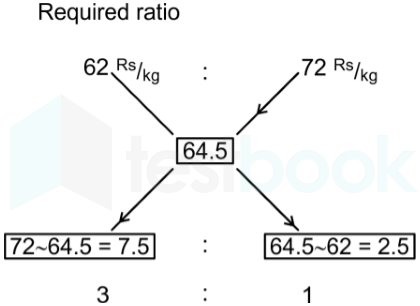
Hence, required ratio would exist 3:i.

Go along Reading in App
-
four

Rita Has Two Small Containers,
Source: https://testbook.com/blog/ratio-proportion-quiz-1-for-banking-and-insurance-exams/
Posted by: lowestas1964.blogspot.com
0 Response to "Rita Has Two Small Containers"
Post a Comment